When we think about our children and school, we naturally think about what they are learning—the books they are reading, the maths they are doing, the projects they are working on. But there is another side to learning that can be a little harder to see. It is in the questions they ask, how they handle something that doesn’t go as planned, how they listen to someone else’s point of view, and how they learn from their experiences.
The world our children are growing up in is complex, diverse, and constantly changing. Schools therefore have a responsibility that goes beyond preparing good mathematicians, scientists, writers, or historians. Education is also about developing young people who can make thoughtful decisions, work with others, consider different perspectives, and contribute meaningfully to their communities (Renaud, 1991, as cited in IBO, 2008). The International Baccalaureate (IB) Learner Profile (LP) reflects this broader view of education, focusing not only on what students learn, but also on the qualities and dispositions they become along the way.
So, what is the IB Learner Profile?
Established in 2006 following two years of consultation with IB schools around the world, the IB LP provides a set of competencies aimed at developing the whole person as a lifelong learner. These attributes are intended to become an integral part of the wider school community, shaping learning and the experiences of those within it.
The IB Learner Profile is, in many ways, the IB mission statement in action and serves as a focus for developing a sense of continuum between programmes (IBO, 2006). It brings the values of the IB mission into everyday learning and provides a shared purpose for students, teachers, and the wider school community (IB, 2015, as cited in Wells, 2011). Hill (2016) describes the LP as a common bond across the diverse community of IB schools and an important part of developing internationally minded learners.
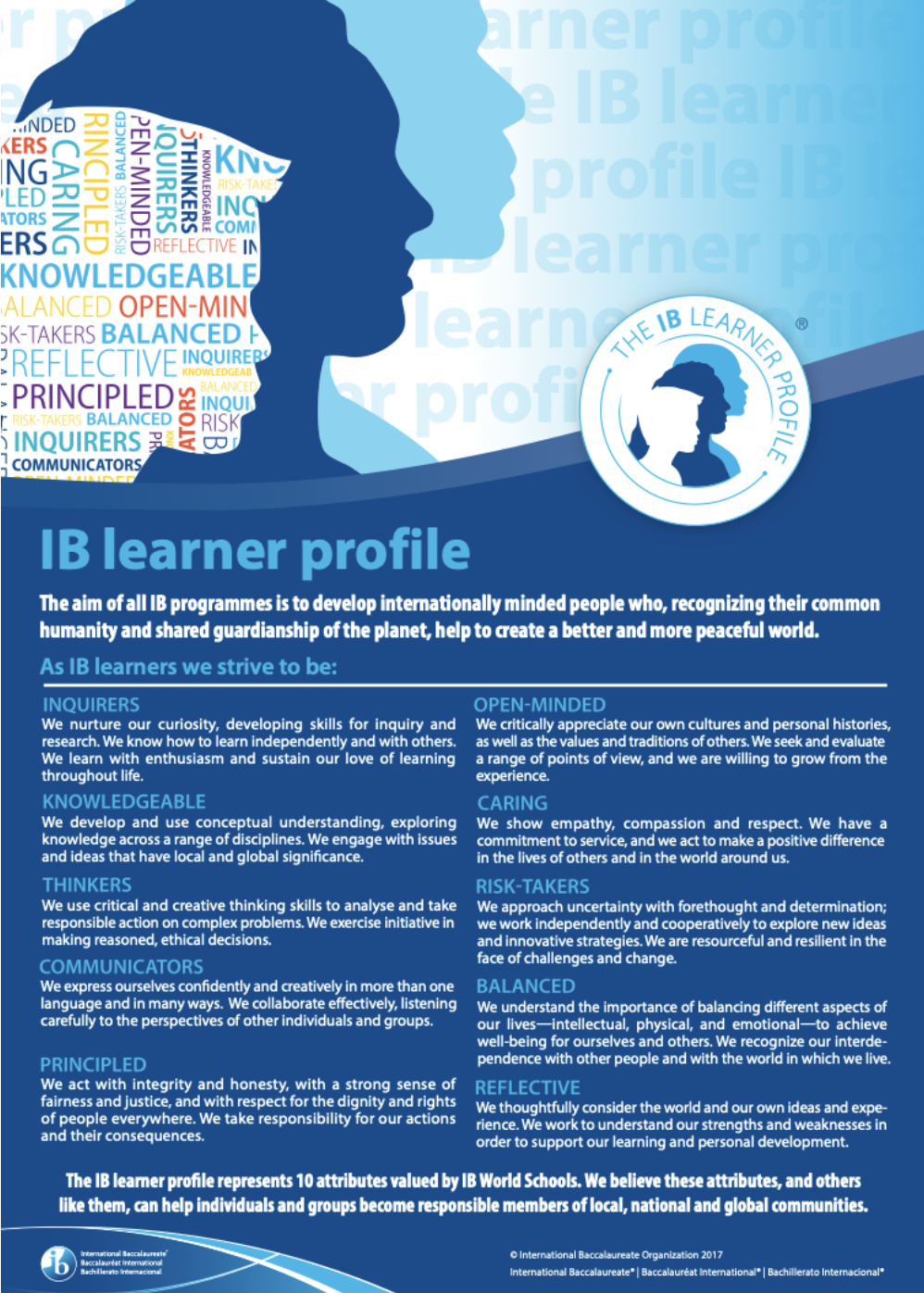
The LP consists of the following ten dispositions that collectively define an international-minded learner (IB, 2006): Inquirers, Knowledgeable, Thinkers, Communicators, Principled, Open-minded, Caring, Risk-takers, Balanced and Reflective..
While the attributes are often presented as ten individual qualities, they are closely connected. Bullock (n.d.) groups them into four broad themes, which help us understand the different dimensions of learning and development they represent.
The cognitive or intellectual theme includes Knowledgeable, Thinkers, and Reflective. These attributes focus on developing knowledge and understanding, thinking critically, making connections, and becoming increasingly aware of and responsible for one’s own learning.
The conative or personal theme includes Inquirers and Principled. These attributes relate to personal intention, self-efficacy, and taking responsibility for and being aware of one’s own learning.
The affective or emotional theme includes Caring, Risk-takers, and Balanced. These qualities support well-being, self-belief, emotional development, social responsibility, and the confidence to step beyond what feels familiar.
The cultural or social theme includes Communicators and Open-minded. These attributes recognize that learning happens in relationship with others and involves listening, collaborating, communicating ideas, and considering and evaluating different perspectives.
Together, these four dimensions remind us that education is about developing the whole person, not simply academic knowledge.
What does it look like in everyday life?
The Learner Profile comes to life in the small moments of learning.
An Inquirer asks a question because they genuinely want to understand. A Thinker considers different possibilities before making a decision. An Open-minded learner listens to a perspective that differs from their own. A Risk-taker tries something unfamiliar, even when they are unsure. A Principled learner makes a responsible choice, while a Reflective learner pauses to consider what worked and what they might do differently.
These qualities are not confined to the classroom. They can be seen when a child listens to a sibling, helps a friend, tries a new activity, persists with something challenging, or thinks about how their actions affect others. The goal is not for children to simply say, “I am reflective” or “I am caring.” These are dispositions that develop gradually through experiences, relationships, opportunities, and reflection.
It takes a community
An important part of the Learner Profile is that it applies to adults as well as students. Teachers, school leaders, and parents are encouraged to model these attributes because children learn not only from what we teach, but also from what they see us do (IBO, 2009, as cited in Wells, 2011). When we say, “I hadn’t thought about it that way before,” we model open-mindedness. When we acknowledge a mistake and think about what we could do differently, we model reflection. When we encourage a child to try something that feels uncomfortable, we support them in being a risk-taker. These everyday moments matter.
More than ten words
Perhaps the simplest way to think about the Learner Profile is this: It is not a list of things we want our children to say they are. It is a set of qualities we hope they will gradually learn to live by. We want our children to be curious, thoughtful, courageous, caring, principled, open to different perspectives, and willing to reflect and grow. And we want all of us—teachers, parents, and the wider school community—to model these qualities along the way.
Because ultimately, the Learner Profile asks us to look beyond “What has my child learned?” and consider the bigger question: “What kind of learner—and what kind of person—is my child becoming?”
I would love to hear your thoughts.
Priya Murali
PYP Coordinator
Riverstone International School
pmurali@riverstoneschool.org